
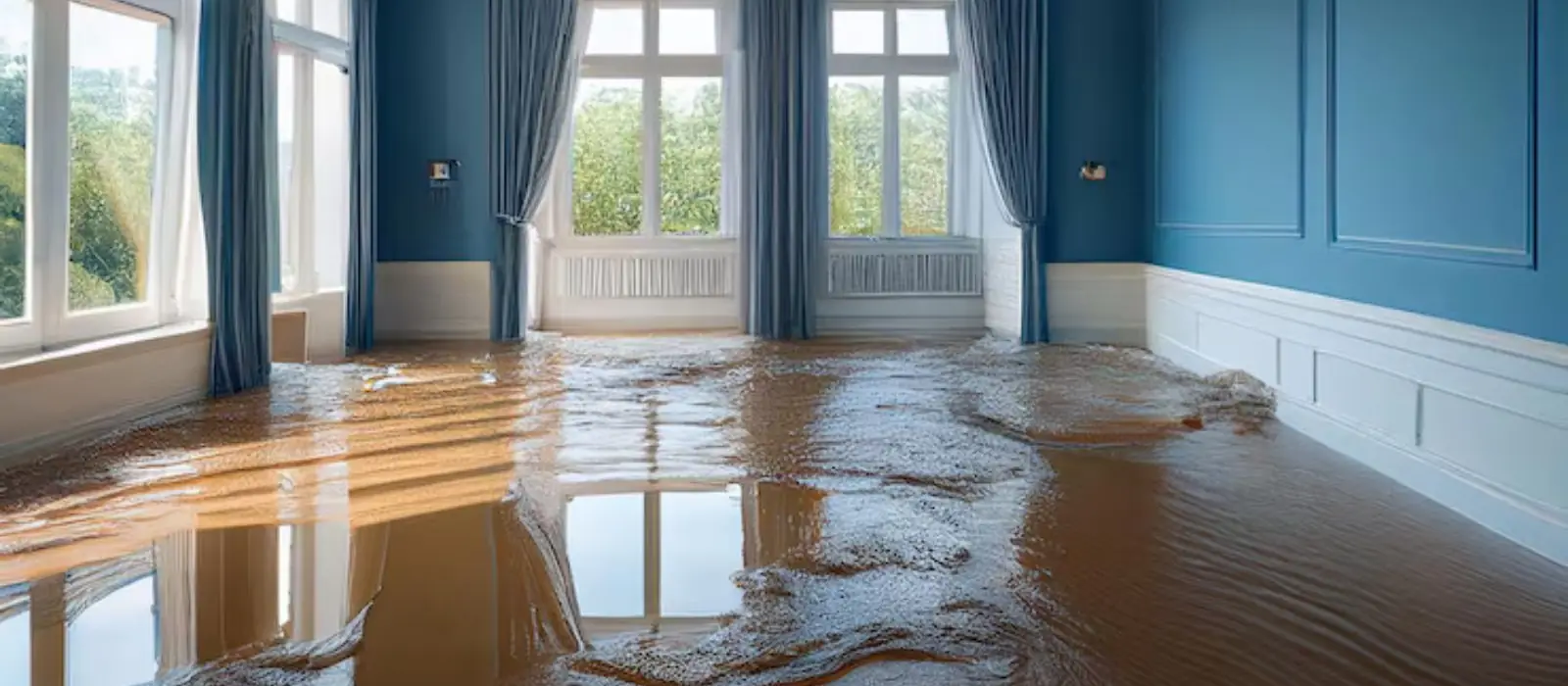
A hardwood floor that gets wet starts changing within hours. Boards absorb moisture, swell and begin to cup, and the earlier drying starts, the better the odds of saving the floor.
This guide covers what to do first, how drying works and how to tell whether a floor will be refinished, repaired or replaced. It applies to solid and engineered wood floors.
What happens when wood gets wet
Wood is hygroscopic, which means it takes on moisture from its surroundings. When water reaches a board, the board swells. If the moisture comes from below, the underside swells more and the edges lift. That lift is called cupping.
Crowning, where the center of the board rises, can follow when floors are sanded before they are fully dry. Cracks and gaps can show up as boards shrink after drying. Each depends on how fast the water was removed.
The first day
- Stop the source. Close the valve or contain the leak.
- Remove standing water with a mop or wet vacuum if it is clean and away from power.
- Lift furniture, rugs and anything that traps moisture on the floor.
- Do not use heat to speed drying. Heat can crack boards.
- Photograph the floor and the source.
- Call the 24/7 line so moisture can be mapped and drying started.
How a crew dries a hardwood floor
- 1
Meter the boards
Moisture meters read the boards and the subfloor to see how deep the water went.
- 2
Extract
Surface and trapped water are removed.
- 3
Dry
Air movers and dehumidifiers run, and mats or panels may pull moisture from the boards.
- 4
Monitor
Readings are logged until the floor reaches a safe moisture level.
Drying is controlled. Too slow and mold can start. Too fast and the wood can crack. The crew adjusts equipment as readings change.
Saved, refinished or replaced
| Condition after drying | Usual outcome | Why |
|---|---|---|
| Mild cupping that eases as it dries | Often sanded and refinished | Boards settle and can be leveled |
| Cupping that stays or cracks in boards | Spot or board replacement | Damage is localized |
| Wide buckling or loose boards | Replace the floor section | Boards and fastening have failed |
| Dirty water exposure | Often replaced | Contaminated porous material is removed |
Sanding comes only after the boards are dry. Many floors need some weeks to settle before a refinish gives a stable result. The crew will tell you honestly if your floor is unlikely to recover.
What it means for repair
If boards must be replaced, a match to the old floor can be tricky. Sanding the whole room and refinishing it together is the usual way to blend new and old boards. Read about the rebuild on the water damage repair page.
Wood floor wet right now?
Call the 24/7 line. Drying early makes the biggest difference.
Solid, engineered and floating floors react differently
Solid hardwood can often be dried, sanded and refinished because the whole board is wood. Engineered flooring has a thin wood layer over a core, and water can make the layers separate. Floating floors have seams that can swell and curl at the edges.
Tell the crew which type you have and, if you know it, the brand and the age. A manufacturer may have moisture limits that affect what can be saved. If standing water is still on the floor, start with emergency water removal and then move to drying.
Do not seal a damp floor under rugs, plastic or a new coat of finish. Trapped moisture is how cupping turns into permanent warping, and it can also feed growth under the boards.
Santa Monica local note: where the water starts
According to the City of Santa Monica's 2025 water quality report, the city gets up to 75 percent of its water from local groundwater wells and buys the rest from the Metropolitan Water District. A leak from a supply line in your home starts as clean water.
Clean water is the best case for a wood floor. The risk grows with time and with whatever the water crosses on the way. A slow leak under a floor is much worse than a quick spill because the boards stay wet and the subfloor holds moisture.
Ask a plumber to check lines under the floors of older homes in Pico and Sunset Park after a leak. If you are in Venice or Pacific Palisades, the City of Los Angeles water system supplies the same kind of supply-line risk.
Questions homeowners ask
Often, if it is dried slowly and the moisture is gone. Sanding too soon can lock in cupping. Give a floor time to settle before refinishing.
Not before a crew checks. Lifting boards can damage the tongue and groove, and a crew may use mats or panels that need the boards in place.
A fan alone is not enough, and heat can crack boards. A crew uses air movers with dehumidifiers and monitors readings.
Engineered floors have layers that can delaminate when wet. They often handle some moisture but tolerate it differently. The crew checks the product and the readings.