
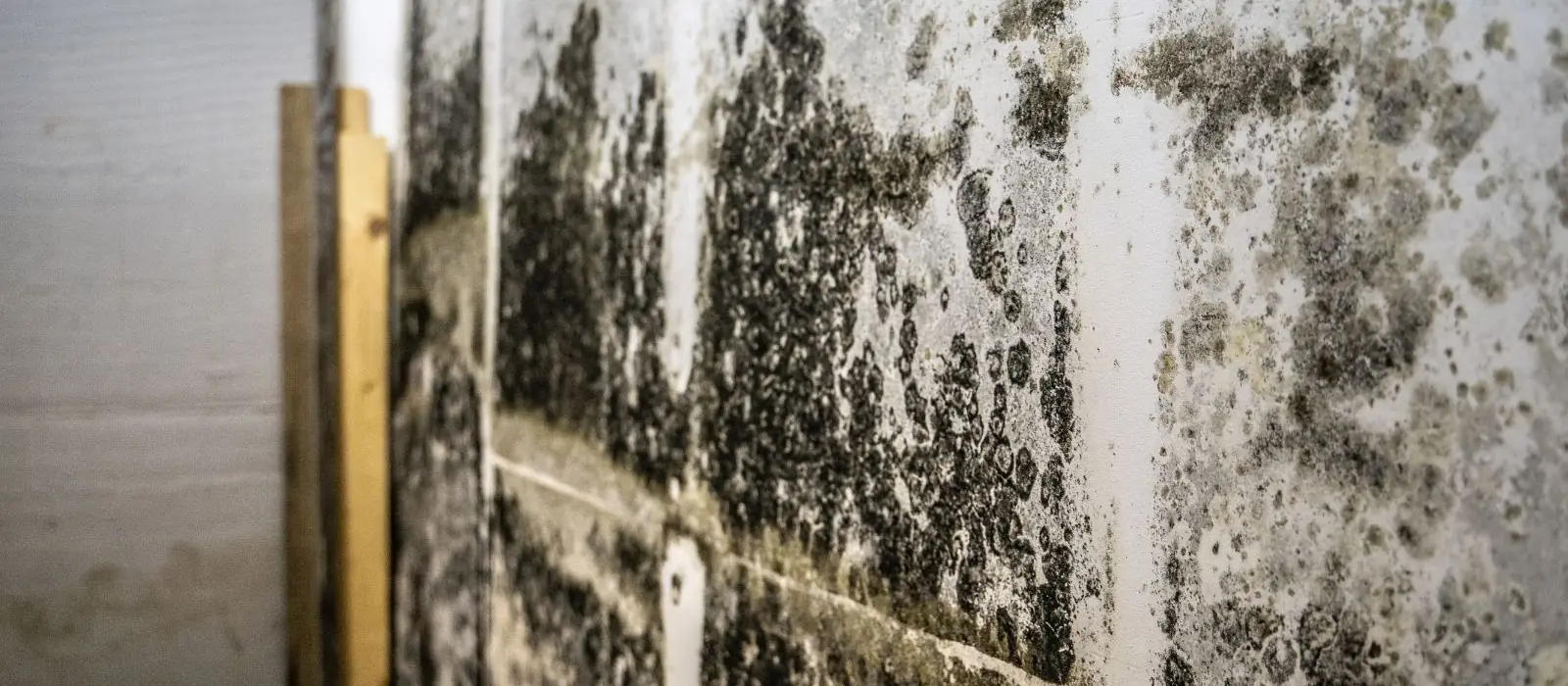
Basement mold keeps returning for one reason: the moisture never left. Cleaning without drying and without fixing the source is a temporary result that fades in weeks.
This guide walks through what to fix first, what a homeowner can reasonably clean and what needs a crew with containment. It covers below-grade garages, lower-level rooms and crawl spaces as well as true basements.
Step one: find the moisture source
Look for the cause before the cleanup. Check plumbing lines and the water heater, look for water stains where walls meet the floor, watch the room after rain and run a dehumidifier for a day to see how much water it collects. A lot of water collected in a day points to ongoing humidity or seepage.
If the source is a plumbing leak, a plumber must fix it. If it is groundwater or runoff, a drainage contractor may be needed. A restoration crew handles the damage the water caused.
Step two: decide what is surface growth
| Material | Small surface spot | Larger or embedded growth |
|---|---|---|
| Concrete and tile | Often cleanable | Needs containment if widespread |
| Sealed wood | Often cleanable | Assess depth first |
| Drywall | Usually removed | Remove with containment |
| Carpet and pad | Usually removed | Remove with containment |
| Insulation | Usually removed | Remove with containment |
Porous materials hold growth inside, so cleaning the surface does not reach it. Hard surfaces are the best candidates for careful cleaning.
Step three: dry the space
A dehumidifier is the main tool for ongoing damp. Run one with doors closed and empty it or drain it to a floor drain. Use a moisture meter, or ask the crew to, to confirm that walls and framing are dry before you close anything up.
Air movers help after a water event, but a fan alone will not dry a basement. Without dehumidification, a fan just moves damp air around. See water mitigation for how crews dry whole spaces.
When to call a crew
- The growth covers more than a small area or is spreading.
- It is on drywall, carpet, insulation or stored boxes.
- The smell returns after you clean.
- Water came from sewage or flooding.
- You need written proof for a sale, a lease or a loan.
A crew sets containment, removes affected materials, cleans with HEPA tools and verifies the result. Clearance testing by an independent tester gives written results when you need them. Read more on the mold remediation page.
Keeping it from coming back
Control humidity, fix leaks promptly, keep stored items off the floor and give air room to move behind shelves. Check the space after heavy rain. If a smell returns, assume moisture has returned and look for it.
Lower-level mold you cannot clear?
Call the 24/7 line. Dispatch explains scope and price before work starts.
A short checklist after storms
- Walk the lower level within a day of heavy rain and look at floors, wall bases and stored boxes.
- Smell the room. A new musty odor is an early sign of moisture.
- Check the dehumidifier tank and the drain line.
- Look behind shelves and furniture pushed against exterior walls.
- Photograph anything new so you can compare later.
Catching a damp patch early is the difference between a wipe-down and a removal job. If water did enter, the drying steps under water damage cleanup apply, and the earlier they start the better.
Santa Monica and Venice local note: low ground
Low ground behaves differently from a hillside. Venice, just south of Santa Monica, sits about 10 feet above sea level. Its canals were dug to drain marshland, and the Windward Circle traffic circle occupies the site of a former lagoon, according to published histories of the area.
If you live on low ground near the coast, expect more moisture in lower levels and plan for it. Dry stored items off the floor, run dehumidification in damp seasons and check for water after storms. See the Venice page for coverage there.
Hillside homes have their own pattern. See Pacific Palisades for the lower levels near Pacific Coast Highway and the canyon runoff above them.
Questions homeowners ask
Bleach works on non-porous surfaces at the surface only, and it adds moisture to porous materials. It does not remove the growth inside drywall or wood. A crew uses cleaning and removal methods suited to the material.
It helps control humidity, which mold needs. It does not remove growth that is already there or fix a leak. Use it with source repair and, where needed, remediation.
Many homes here do not have one, but below-grade garages, lower-level units and crawl spaces are common enough that the same moisture rules apply. If your home has none of these, the guide still applies to any damp lower room.
A moisture meter reading that matches an unaffected area of the same material is the standard. A room that feels dry is not proof. Ask the crew to show you the readings.